
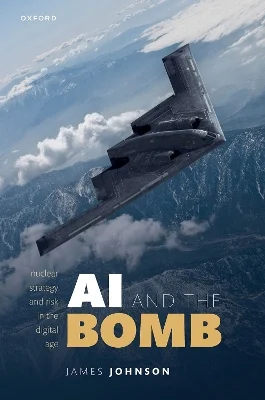
Description
By (author) Johnson, James
Short /annotation:
This book provides a coherent, innovative, and multidisciplinary examination of the potential effects of AI technology on nuclear strategy and escalation risk. Its findings have significant theoretical and policy ramifications, as well as contributing to the literature on the impact of military force and technological change.
:
Will AI make accidental nuclear war more likely? If so, how might these risks be reduced? AI and the Bomb provides a coherent, innovative, and multidisciplinary examination of the potential effects of AI technology on nuclear strategy and escalation risk. It addresses a gap in the international relations and strategic studies literature, and its findings have significant theoretical and policy ramifications for using AI technology in the nuclear enterprise. The book advances an innovative theoretical framework to consider AI technology and atomic risk, drawing on insights from political psychology, neuroscience, computer science, and strategic studies. In this multidisciplinary work, James Johnson unpacks the seminal cognitive-psychological features of the Cold War-era scholarship, and offers a novel explanation of why these matter for AI applications and strategic thinking. The study offers crucial insights for policymakers and contributes to the literature that examines the impact of military force and technological change.
Table of contents:
AcknowledgementsList of figures and tablesList of abbreviationsIntroduction: AI and nuclear weapons1: Strategic stability: A perfect storm of nuclear risk?2: Nuclear deterrence: New challenges for deterrence theory and practice3: Inadvertent escalation: A new model for nuclear risk4: AI-security dilemma: Insecurity, mistrust, and misperception under the nuclear shadow5: Catalytic nuclear war: New ”Nth country problem” in the digital age?Conclusion: Managing the AI-nuclear strategic nexusIndex
Review quote:
Johnson makes an important contribution in this excellent book.
Review quote:
The book seems intended for theorists and scholars of strategic studies, but it should also be crucial reading for policy-makers, especially from nuclear states.
Biographical note:
James Johnson is a Lecturer in Strategic Studies in the Department of Politics and International Relations, University of Aberdeen. He is also an Honorary Fellow at the University of Leicester, a Non-Resident Associate on the ERC-funded ”Towards a Third Nuclear Age” Project, and a Mid-Career Cadre with the Center for Strategic and International Studies (CSIS) Project on Nuclear Issues. Previously, he was an Assistant Professor at Dublin City University, a Non-Resident Fellow with the Modern War Institute at West Point, and a Postdoctoral Research Fellow at the James Martin Center for Nonproliferation Studies in Monterey.
Publisher’s notice:
James Johnson is a Lecturer in Strategic Studies in the Department of Politics and International Relations, University of Aberdeen. He is also an Honorary Fellow at the University of Leicester, a Non-Resident Associate on the ERC-funded ”Towards a Third Nuclear Age” Project, and a Mid-Career Cadre with the Center for Strategic and International Studies (CSIS) Project on Nuclear Issues. Previously, he was an Assistant Professor at Dublin City University, aNon-Resident Fellow with the Modern War Institute at West Point, and a Postdoctoral Research Fellow at the James Martin Center for Nonproliferation Studies in Monterey.
Version history:
Offers the first multidisciplinary empirical and theoretical examination of the AI-nuclear strategic nexusConsiders Cold War-era theories and concepts about nuclear strategy in light of emerging security challenges in the digital ageAdvances a novel theoretical explanation of the effects of AI on nuclear strategic thinkin


Reviews
There are no reviews yet.