
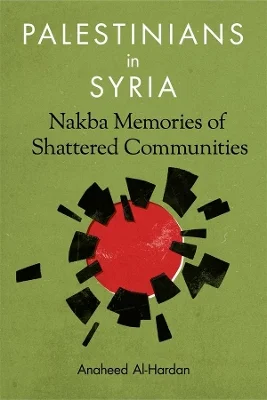
Description
By (author) Al-Hardan Anaheed
:
One hundred thousand Palestinians fled to Syria after being expelled from Palestine upon the establishment of the state of Israel in 1948. Integrating into Syrian society over time, their experience stands in stark contrast to the plight of Palestinian refugees in other Arab countries, leading to different ways through which to understand the 1948 Nakba, or catastrophe, in their popular memory.
Conducting interviews with first-, second-, and third-generation members of Syria”s Palestinian community, Anaheed Al-Hardan follows the evolution of the Nakba—the central signifier of the Palestinian refugee past and present—in Arab intellectual discourses, Syria”s Palestinian politics, and the community”s memorialization. Al-Hardan”s sophisticated research sheds light on the enduring relevance of the Nakba among the communities it helped create, while challenging the nationalist and patriotic idea that memories of the Nakba are static and universally shared among Palestinians. Her study also critically tracks the Nakba”s changing meaning in light of Syria”s twenty-first-century civil war.
Table of contents:
Note on Transliteration and Names
Preface and Acknowledgments
Introduction: The Catastrophe of 1948, the Catastrophes of Today
1. The Nakba in Arab Thought
2. The Palestinian Refugee Community in Syria
3. The Right of Return Movement and Memories for the Return
4. Narrating Palestine, Transmitting Its Loss
5. The Guardians” Communities and Memories of Catastrophes
6. Second- and Third-Generation Postmemories of Palestine and Narratives on Nakba Memory
Conclusion: The Catastrophes of Today, the Catastrophe of 1948
Notes
Bibliography
Index
Review quote:
Palestinians in Syria is an original exploration of the evolution of memories of the traumatic events of the Nakba which affected the entire Arab population of Palestine in 1948. It skillfully traces how understanding of the valence and meaning of these events has changed over time. This book also constitutes the first major study of the Palestinian community in Syria, and it takes on added importance in light of the violent displacement of most of this community during the bitter fighting in and around Yarmouk camp near Damascus.
Review quote:
This extremely important and timely book provides a vivid portrait of the Palestinian refugee community in Syria—a community now dispersed by the war in that country. In its detailed analysis of Palestinian memories and histories of the devastating events of 1948, this study succeeds in demonstrating how the socially and economically integrated Palestinians in Syria were somehow different from other Palestinian refugees in the region. Although this book is about the Catastrophe of 1948, it is also about the Palestinian catastrophe in Syria today.
Review quote:
What drives Palestinians in Syria is not the events of the Nakba but rather Nakba memories transferred through three generations, from those who experienced it up to the young of today. Anaheed Al-Hardan places her own identity as a third-generation refugee at the center of her thinking about uprooting and of her interactions with participants in her study, and she reflects critically on how this affected her research. She also carried out her research in a Palestinian exile region hardly touched by other researchers and has managed to incorporate effects of the ongoing civil war that has re-displaced thousands of Palestinian refugees in a new uprooting.
Review quote:
Al-Hardan’s mastery of historical context; her nuanced approach to thesymbolic nature of memory-making-for community-building among threegenerations of refugees; and her clear-eyed articulation of acatastrophe of catastrophes is as groundbreaking as it isheart-wrenching.
Revi



Reviews
There are no reviews yet.