
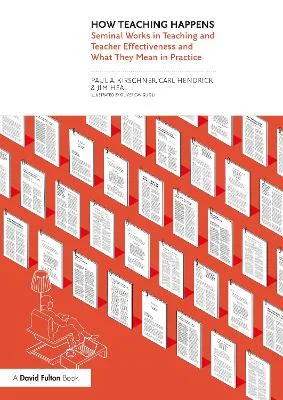
Description
By (author) Kirschner Paul; By (author) Hendrick, Carl; By (author) Heal, Jim
Short /annotation:
Building on their bestselling book How Learning Happens, Paul Kirschner and Carl Hendrick are joined by Jim Heal to explore how teaching happens. The book seeks to closely examine what makes for effective teaching in the classroom and how research on expert teaching can be used in practice.
:
Building on their bestselling book How Learning Happens, Paul A. Kirschner and Carl Hendrick are joined by Jim Heal to explore how teaching happens. The book seeks to closely examine what makes for effective teaching in the classroom and how research on expert teaching can be used in practice.
Introducing 30 seminal works from the field of education psychology research, the learning sciences, and teaching effectiveness studies, each chapter takes an important work and illustrates clearly and concisely what the research means and how it can be used in daily practice. Divided into six sections the book covers:
• Teacher Effectiveness, Development, and Growth
• Curriculum Development / Instructional Design
• Teaching Techniques
• Pedagogical Content Knowledge
• In the Classroom
• Assessment
The book ends with a final chapter on “What’s Missing?” in how teachers learn to teach.
Written by three leading experts in the field with illustrations by Oliver Cavigioli, How Teaching Happens provides a clear roadmap for classroom teachers, school leaders, and teacher trainers/trainees on what effective teaching looks like in practice.
Table of contents:
Preface Section 1: Teacher effectiveness, development, and growth1. An Experienced Teacher ≠ An Expert Teacher 2. Those Who Understand, Teach 3. Teachers Are Made, Not Born 4. Teachers Are Made, Not Born 5. I Think, Therefore I Teach 6. When Thinking and Acting Become One Section 2: Curriculum development / Instructional design 7. It’s all about alignment 8. Pebble in the Pond 9. How to tell the Story of an Idea 10. If you don’t know where you’re going, you might wind up someplace else Section 3: Teaching Techniques 11. There’s No Such Thing as a Child Who Can’t Be Taught 12. Burning the Strawman 13. Make Something of what You’ve Learnt 14. Learning: No Pain, No Gain 15. Step for Step
Section 4: Pedagogical content knowledge 16. Why You Can’t Teach What You Don’t Know 17. Mathematical Knowledge for Teaching 18. The Science of Science Teaching 19. Three Chords and the Truth 20. How Should we Teach Reading? 21. Why Technology Should be the Servant not the Master? Section 5: In the classroom 22. “To Thine Own Self Be True”: The Authentic Teacher 23. Relationally Speaking 24. Why Relationships Matter 25. Teachers as Intelligent Consumers Section 6: Assessment 26. The Many Faces and Uses of Assessment 27. When Testing Kills Learning 28. Don’t Ask Questions That Don’t Require Understanding to Answer 29. Why Teaching to the Test is So Bad 30. Hocus-Pocus Teacher Education End notes Glossary Index
Review quote:
“Evidence-informed education does not sit still; it is a discussion constantly taking place. Findings are never fixed; they are renewed and invigorated by subsequent exploration. This book is a vital part of the revolution happening in classrooms around the world and marks a new frontier in its evolution.”
Tom Bennett OBE, Founder of researchED
“This is a terrific collection of some of thought-provoking and actionable articles about classroom teaching. The selections are sure to inform and challenge readers, and certainly will help them understand teaching better. It is also not farfetched to imagine that critical thinking about these articles will lead to better teaching.”
David C.


Reviews
There are no reviews yet.