
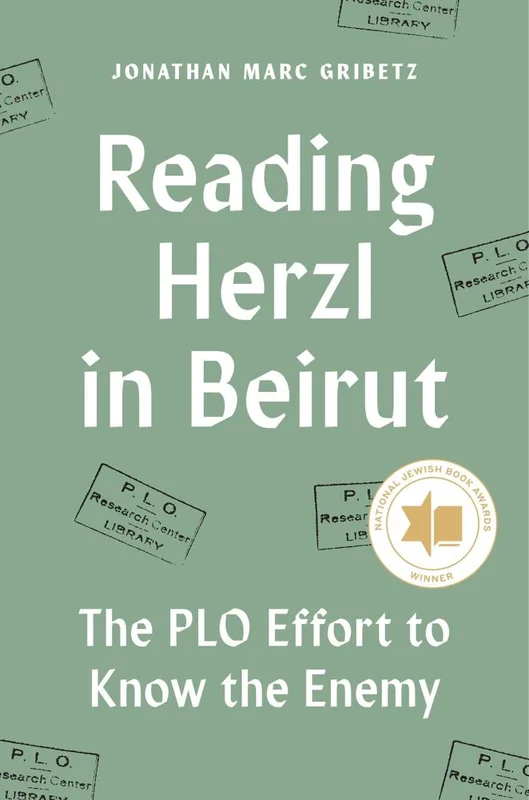
Description
By (author) Gribetz, Jonathan Marc
:
How the Palestine Liberation Organization Research Center informed the PLO’s relationship to Zionism and Israel
In September 1982, the Israeli military invaded West Beirut and Israel-allied Lebanese militiamen massacred Palestinians in the Sabra and Shatila refugee camps. Meanwhile, Israeli forces also raided the Palestine Liberation Organization Research Center and trucked its complete library to Israel. Palestinian activists and supporters protested loudly to international organizations and the Western press, claiming that the assault on the Center proved that the Israelis sought to destroy not merely Palestinian militants but Palestinian culture as well. The protests succeeded: in November 1983, Israel returned the library as part of a prisoner exchange. What was in that library?
Much of the expansive collection the PLO amassed consisted of books about Judaism, Zionism, and Israel. In Reading Herzl in Beirut, Jonathan Marc Gribetz tells the story of the PLO Research Center from its establishment in 1965 until its ultimate expulsion from Lebanon in 1983. Gribetz explores why the PLO invested in research about the Jews, what its researchers learned about Judaism and Zionism, and how the knowledge they acquired informed the PLO’s relationship to Israel.
Review quote:
“Winner of the National Jewish Book Award in History, Jewish Book Council”
Review quote:
“Honorable Mention for the Shapiro Best Book Prize, Association for Israel Studies”
Review quote:
“A comprehensive and lucid account of the [Palestine Liberation Organization’s Research Center] and the Israeli raid that altered the trajectory of its existence.”
—Sheldon Kirshner, The Times of Israel
Review quote:
“Meticulous and original. . . . [Reading Herzl in Beirut] is a testament to the Center”s intellectual legacy and its role in shaping Palestinian nationalist thought. Gribetz”s balanced narrative gives room for a wider discussion about Palestinian nationalism and thought that, on the one hand, is adversarial to Zionism and Israel, but also recognizes the material presence and engagement with a country and a people already integrated into their shared yet contested space.”
—Etan Nechin, Haaretz
Review quote:
“[A] fascinating book.”
—Lisa Anderson, Foreign Affairs
Review quote:
“A deeply researched book.”
—Emad Al-Ahmad, Al Majalla
Review quote:
“Fascinating and insightful.”
—Sara Jo Ben Zvi, Segula
Review quote:
“Judicious, balanced, and empirically neutral. . . . The narrative that Gribetz unfolds . . . is wonderfully empathetic. . . . His deep dive into the political thought of the center’s founders and researchers, and into the cultural and ideological influences to which it was subject . . . delivers a powerful human story.”
—Yezid Sayigh, Diwan
Review quote:
“A clear-headed and sober analysis of the PLO Research Center. . . . Reading Gribetz’s book in its entirety is essential for gaining a comprehensive understanding of this topic.”
—Amir Nassar, The Tel Aviv Review of Books
Review quote:
“Not only does [Reading Herzl in Beirut] tell the story of a research center’s work that embodied the Palestinian struggle, but it also reveals a rare painstaking research of primary resources that offers an old and yet fresh perspective on the evolution of the Israeli-Palestinian conflict and an understanding of how perspectives of the enemy and yourself matter, an understanding that is more crucial than ever.”
—Marina Eleftheriadou, Bustan
Review quote:
“Gribetz’s book makes a significant contribution to the study of Jewish–Palestinian relations, particular




Reviews
There are no reviews yet.