
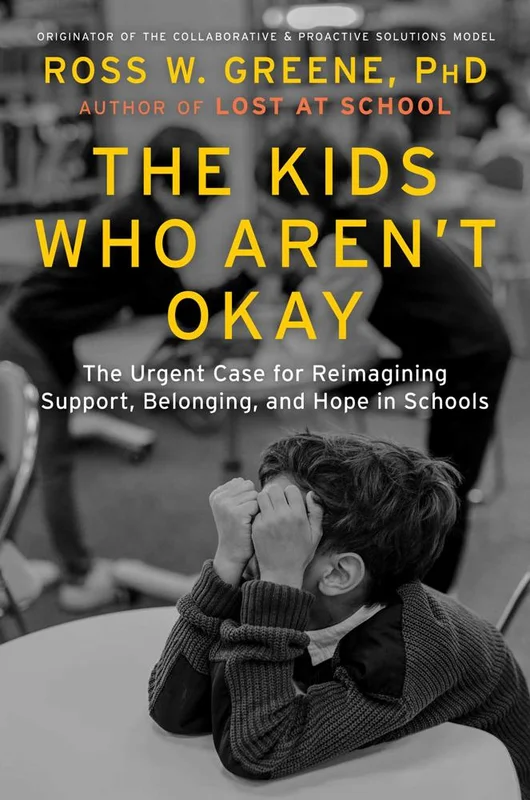
Description
By (author) Greene Ross W.
Short /annotation:
From the renowned New York Times bestselling authority on education and parenting, a transformative guide to navigating behavioral challenges in the classroom that distinguishes between crisis management and crisis prevention—a lens shift that ameliorates the school experience for our most vulnerable kids and their caregivers.
:
From a New York Times bestselling authority on education and children’s mental health comes a groundbreaking guide to navigating classroom challenges through an approach that is aimed at meeting kids where they’re at and being responsive to the developmental variability inherent in every classroom.
Over the past two decades, a wide array of societal changes have made it much harder to be a kid. While lots of kids are still doing okay, many more than ever are not. The Kids Who Aren’t Okay opens with sobering statistics on children’s mental health: higher than ever rates of concerning behaviors at school, anxiety, depression, chronic absenteeism, and suicidality. And educators—who have never felt less safe at school, have experienced significant decreases in job satisfaction, and have left the profession in droves—aren’t doing very well, either.
Child psychologist Dr. Ross Greene, renowned for his pioneering work in education and originator of the evidence-based Collaborative & Proactive Solutions model (which has transformed practices in countless families, schools, psychiatric units, and residential and juvenile detention settings), has worked in and with schools across the globe for decades. He argues that the moment demands that we renew our focus on developmental variability and meeting every student where they’re at, and that we take a hard look at our structures, practices, and mentalities at school and make practical, actionable, realistic changes that benefit all kids and educators. These changes must include shifting to interventions that are proactive (early) rather than reactive (late), solutions that are collaborative rather than unilateral, and focused on the problems that are causing concerning behaviors (and solving them) rather than behaviors (and modifying them).
Building on the principles introduced in his landmark, bestselling book, Lost at School, Greene equips educators and caregivers with the tools to foster safer, more supportive, inclusive learning environments. In easy-to-understand, practical terms, Greene provides a clear road map for turning things around, complete with vignettes, case studies, and the voices of educators who’ve done it. The Kids Who Aren’t Okay is a vital resource, providing hope and guidance as schools navigate the new normal.
Review quote:
“A powerful exhortation to get teachers more involved in student success.”
—Kirkus
“This model ultimately saves time and effort, and is supported by a significant research base showing its effectiveness in reducing behavioral issues and improving student success. The book will appeal to parents, educators, and policymakers.”
—Booklist
“This critical book reminds us that, now more than ever, we must address the growing issue of students struggling with trauma and social/emotional challenges. Working together as parents and educators we can change things for the better and make a real impact on children”s lives.” —
Yvonne Johnson, National PTA President
“The Kids Who Aren’t Okay arrives as an essential resource… sure to shape the thinking of educators, school leaders, and policy makers who seek solutions to the worsening cycle of behaviors, punitive responses, and exacerbated problems. Offering hope, direction, and practical guidance to support implementation, The Kids Who Aren”t Okay provides both the rationale and


Reviews
There are no reviews yet.