
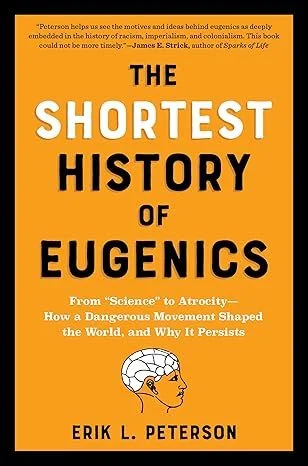
Description
By (author) Peterson Erik
Short /annotation:
A harrowing history of a grim chapter in politics and science, in which groups of influential thinkers shaped global policy with the aim of determining who had the right to have children—and who was worthy of life. The Shortest History books deliver thousands of years of history in one riveting, fast-paced read.
:
For the last two centuries, groups of influential men have, in the professed interest of fiscal responsibility, crime reduction, and outright racism, attempted to control who was allowed to bear children. Their efforts, “eugenics,” characterize a movement that over the last century swept across the world—from the US to Brazil, Japan, India, Australia, and beyond—in the form of marriage restrictions, asylum detention, and sterilization campaigns affected millions. German physicians and scientists adopted and then heightened these eugenics practices beginning in 1939, starving or executing those they deemed “life unworthy of life.”
But well after the liberation of Nazi deathcamps, health care workers and even the US government pursued policies worldwide with the express purpose of limiting the reproduction of poor non-whites. The Shortest History of Eugenics takes us back to the founding principles of the movement, revealing how an idea that began in cattle breeding took such an insidious turn—and how it lingers in rhetoric and policy today.
The Shortest History books deliver thousands of years of history in one riveting, fast-paced read.
Table of contents:
Preface: The Good Birth
Part 1: Surviving the Unfittest (c.500 BCE to 1898)
Chapter 1: Managing Fate
Chapter 2: Degenerates
Chapter 3: Natural Born Criminals
Chapter 4: From Sir Francis Galton to Connecticut
Part 2: Making Eugenics a Science (1899-1927)
Chapter 5: The Indiana Plan
Chapter 6: The American Eugenics Triangle
Chapter 7: Studying the Worst of Us
Chapter 8: Legal Scaffolding for Eugenics
Part 3: Cleaning the Race (1919-1945)
Chapter 9: Drowning “the Great Race” Under a “Rising Tide of Color”
Chapter 10: A Global Eugenics Network
Chapter 11: Making America White Again
Chapter 12: Nazi Ties
Chapter 13: To Murder Six Million
Part 4: Population Control (1945-1980)
Chapter 14: A Surplus Colonial Population
Chapter 15: The Population Control Industrial Complex
Chapter 16: The Population Bomb Bomb
Chapter 17: Emergencies
Part 5: Eugenics is Dead; Long Live Eugenics (1980 to today)
Chapter 18: Resistance, Weak and Strong
Chapter 19: From Population Control to Poverty Control
Chapter 20: Sterilizing Criminals Again
Chapter 21: Newgenics?
Sources
Acknowledgments
Index
Review quote:
“Peterson helps us see the motives and ideas behind eugenics as deeply embedded in the history of racism, imperialism, and colonialism. This book could not be more timely.”
Review quote:
“Indispensable. This formidable history of eugenics helps us understand its continued importance in the modern discussion—from the American roots of Nazi atrocity to the continued use of eugenic practices today. It should be required reading.”
Review quote:
“Reckoning with the eugenic past in all its complexity is a task for our times. In The Shortest History of Eugenics, Erik L. Peterson provides a concise survey that nevertheless gives that complexity its due, explaining how scientific idea



Reviews
There are no reviews yet.